The Pain Points of Branding Complex Tech Products
Seven branding problems that show up in almost every tech company we work with — and what to do about each one.
Date
Category
Writer
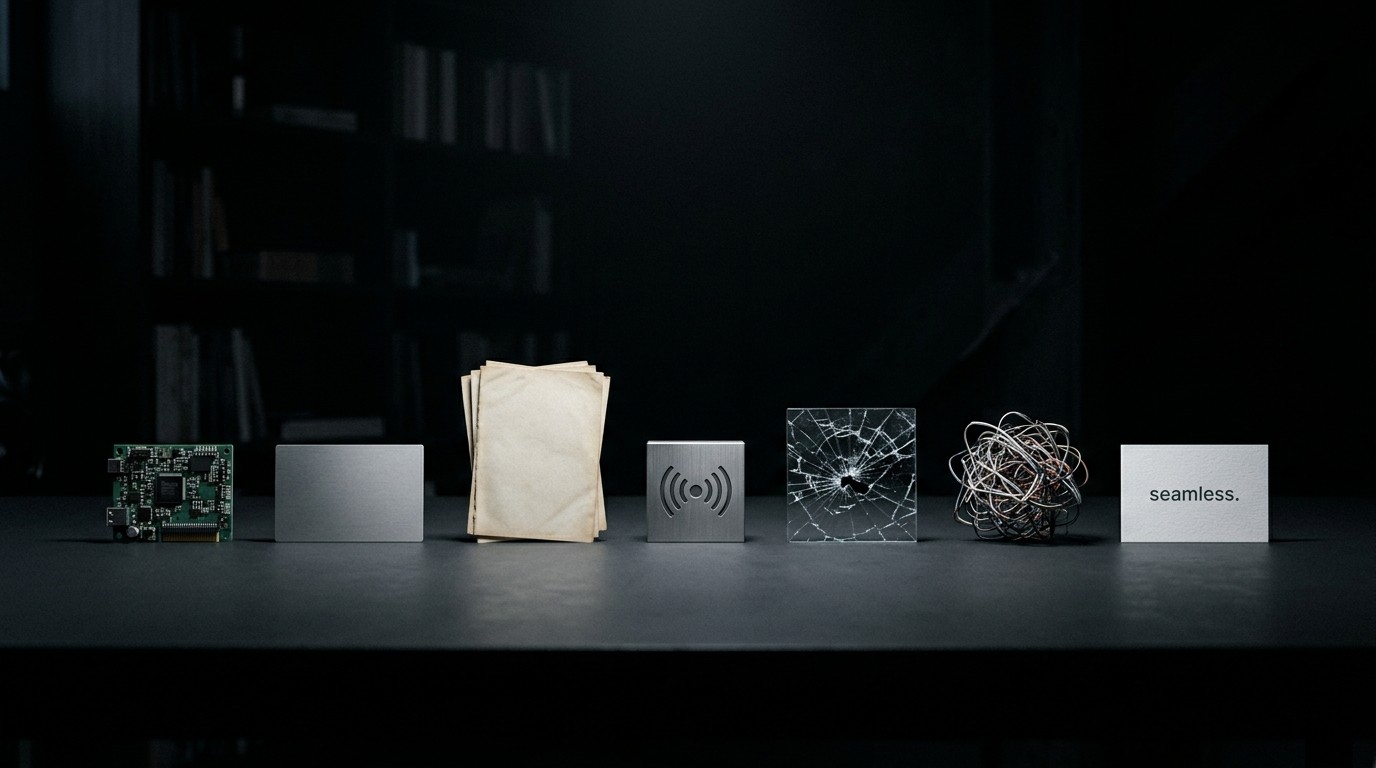
Most tech brands don't have a product problem. They have an explanation problem. We work with companies that build software, AI platforms, and connected hardware. The products are good. The teams are smart. And the same seven problems show up almost every time.
1. The product moves faster than the brand.
Software ships every few weeks. Hardware gets a new generation every year. A brand built around last year's feature list is out of date by the next release.
Brand the problem you solve, not the spec sheet. Features change. The problem usually doesn't. Then build a system flexible enough to absorb the next launch without a redesign.
2. Engineering owns the truth. Marketing owns the story.
Product teams talk in specs, protocols, and edge cases. Buyers want to know what changes for them. When marketing simplifies, engineering calls it wrong. When engineering writes, nobody reads it.
Most brand work stalls right here. We start from the facts and the approved claims, then translate. Every simplification gets checked against the source before it ships. Accurate and clear are not opposites — you just have to do both on purpose.
3. Everyone sounds the same.
"AI-powered." "Seamless." "Next-generation." Read five homepages in any tech category and swap the logos. You won't notice.
When the words are interchangeable, buyers fall back on price. The way out is to be specific. Name the thing that happens. Name the number that changes. Name the person whose day gets easier.
4. The product is invisible.
You can't photograph a security protocol. You can't film an API. A wireless signal has no shape. So tech brands fall back on stock photos of people smiling at laptops, or abstract blue swooshes. Neither explains anything.
This is where motion, 3D, and film earn their cost. A 60-second animation can show how data moves, where the risk sits, and what the product does in the room.
↳ XREAL AURA Spatial computing glasses are literally invisible as a product — the experience lives on your face, not in a photo. When XREAL needed five ads cut from MKBHD's review in 48 hours, the entire job was finding the moments where the product stopped being abstract and became something a viewer could want. Motion did what a spec sheet never could.
5. One product, five audiences.
The person who uses it. The person who owns the budget. The person in IT who signs off on security. The person in procurement. Each one asks a different question.
A brand that answers only one of them loses the deal at the next desk. A good system holds one core idea and lets each audience in through its own door.
6. Volume breaks consistency.
One launch can mean dozens of assets: web pages, ads in every size, decks, event screens, social cuts, regional versions. Each one made in a rush, often by a different hand. By month three the brand looks like five brands.
A thicker guidelines PDF won't fix it. Nobody opens it. A working design system will — templates, components, and rules that make the right choice the easy one.
↳ FUTURI MEDIA Thirteen AI-powered products built over decades, each with its own visual language and naming convention. Two Futuri products sitting side by side didn't look like they came from the same company. We built a full brand architecture — parent identity, sub-brand system across all thirteen products, motion guidelines, voice and tone — designed to absorb whatever they build next. It now serves 7,000+ media brands daily.
7. AI made output cheap. Judgment didn't.
Anyone can generate a hundred visuals by lunch. That produces more sameness, faster.
We use AI across our production. We don't let it decide what to say, what to cut, or what's true. That part is still the job.
What These Have in Common
Every one of these is a clarity problem. The product is dense. The work is to make its structure legible — to the buyer, to the user, and to your own team.
Features are easy to list. Value is hard to show. Most tech brands stop at the list.
Behind the Curtain
A big part of what we do before any design work starts is figuring out which of these seven problems is the actual blocker. Sometimes it's one. Usually it's three. The answer changes what we build, how we sequence it, and where we start. If your product is hard to explain, that's the conversation worth having.
Latest Articles.
© Kanso Studio
Thoughts, ideas, and perspectives on design, simplicity, and creative process.